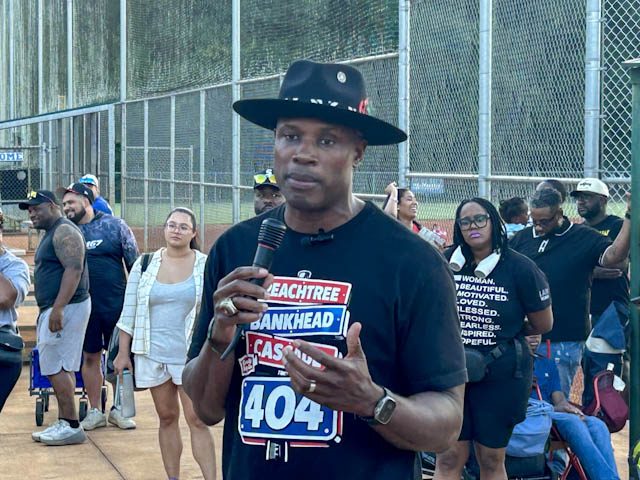
Recently, community leader Jason Burke Allen connected me with Wayne Glapion and his son, Jelani Glapion, founders of Village Rising CommUnity. Jason understands the work my wife, Kelli, and I have spent nearly two decades building through L.E.A.D. Center For Youth in Atlanta, and he saw alignment between our work and what Wayne and Jelani are building.
Village Rising CommUnity is using baseball, softball, education, cultural development, rites of passage, and experiential learning to serve Black youth. Wayne and Jelani are asking important questions about building an organization that can last.
Rather than simply answering their questions privately, I am using what I call my Impact Access Process.
Impact Access allows me to provide complimentary consultation while creating resources that can serve more than one person or organization. I can answer questions through a blog like this, meet with the people who asked them to go deeper, record that conversation with their permission, and repurpose what we learn for others facing similar challenges.
That allows access to my experience without requiring me to repeat the same conversation over and over. It also allows my mistakes, lessons and successes to become resources for others.
Here are the four questions Wayne and Jelani asked me.
- How did you navigate the initial phase of building your support network?
It started with a powerful story that established our why.
Before asking people to support L.E.A.D., Kelli and I had to be clear about why the organization needed to exist.
My context mattered.
I was born and raised in Atlanta, and baseball became a vehicle that helped me move from poverty toward prosperity. Baseball exposed me to opportunities, relationships, discipline and experiences that I otherwise may not have received. Eventually, I realized that I had a responsibility to help provide that same type of access to other young people.
That also connects directly to my faith. I think about the biblical responsibility to be a source of light for people experiencing darkness. There were periods of my life when I was in darkness, and baseball helped me see light.
That became part of the foundation for L.E.A.D.
Context comes before content. Content comes before contact. Contact comes before contest.
Context: Why does this work need to exist?
Content: What exactly are you going to do about it?
Contact: Who needs to become connected to the work?
Contest: Now that the relationships and resources are aligned, how are you going to execute and win?
When building our network, I also learned to distinguish between people who were concerned and people who cared.
Concern can stop at thinking and worrying. Care requires action.
When meeting potential supporters, partners and advocates, I want to know whether they are willing to move from concern to care. Three simple questions can help reveal that:
- What part of this mission connects most with you, and why?
- What resource, relationship or expertise could you contribute to help move this work forward?
- What action would you be willing to take in the next 30 days?
The third question is especially important. Action reveals care.
Over time, those individual relationships become a network. But having a network is not enough. You have to work the network until it produces net worth.
For a nonprofit, that net worth includes both financial capital and social capital.
You cannot have fun without funding. And you cannot create sustainable impact without relationships, credibility, access and people willing to advocate for you when you are not in the room.
- What have been the most effective ways to build sustainable partnerships in Atlanta?
Partnership becomes much easier when you understand what you can actually deliver.
Every organization should develop four lists:
Can Do.
Can’t Do.
Will Do.
Won’t Do.
Those lists create clarity.
Then identify the problems facing the people, companies, schools, government agencies, foundations and communities you want to partner with.
Ask yourself:
What problem do they have that we are equipped to help solve?
That changes the conversation.
Instead of approaching someone saying, “Here is what we need from you,” you can begin by saying, “Here is what we can do for you.”
That is why I believe organizations should become comfortable using two powerful words:
Promise and guarantee.
Do not promise something you cannot deliver. Do not guarantee something you cannot measure. But when you know what you can do, say it clearly.
People are busy. Organizations have goals to accomplish. The strongest partnerships I have experienced are not built around endless meetings. They are built around clearly defined problems, solutions, responsibilities and outcomes.
If you cannot become part of the solution, you can easily become another problem someone has to manage.
Know what you can do. Know what you cannot do. Then execute what you promised.
That builds trust, and trust is what makes partnerships sustainable.
- How do you balance program demands with nonprofit operations?
First, understand this:
A sports-based youth development organization is still a business.
Mission does not eliminate the need for talented people, systems, revenue, accountability and excellent execution.
When resources are limited, involve the young people and families you serve in appropriate aspects of the operation. They should not simply be consumers of programming. They can contribute to building and strengthening the culture and community around the organization.
Second, be clear about the expertise required to do this work.
Volunteerism is valuable, but we cannot expect to volunteer our way out of every challenge affecting young people.
When children and families are navigating poverty, racism, community violence and other adverse childhood experiences, good intentions alone are not enough. Serving them well requires people with appropriate knowledge, training, experience and judgment.
To me, skill comes from the combination of information plus experience.
In the beginning, you may have skilled professionals volunteering their time. As the organization grows, the goal should be to develop sufficient revenue to compensate qualified professionals for critical roles.
Partnerships can help bridge that gap.
Make two lists:
What do we need that we do not currently have?
What do we have that somebody else needs?
Now find the match.
That is partnership.
It should not simply be one organization asking another organization for money. Sustainable partnership creates an exchange of value that helps both parties accomplish something meaningful.
- How do you plant seeds that develop athletes into community leaders and responsible adults with knowledge of self?
I love the language of planting seeds.
But before you plant a seed, you have to till the ground.
After you plant it, you have to nurture it.
Eventually, there needs to be a harvest.
Those are different developmental stages, and each requires intentional programming.
Organizations should also put time around the outcomes they claim they want.
If a child enters your organization at age five and your goal is for that young person to demonstrate meaningful community leadership by age 15, you have ten years to develop the capacities required.
If a child enters at age ten and your long-term vision is to prepare that young person to pursue significant civic leadership as an adult, you may have 15 or 20 years of development to think about.
That changes programming.
Leadership cannot simply be a word in a mission statement.
What does leadership look like at age 8? At 12? At 16? At 18?
What knowledge should the young person possess?
What behaviors should they demonstrate?
What responsibilities should they be trusted with?
What experiences should they have completed?
What metrics will tell you that development is actually occurring?
That is where mission becomes a developmental model.
Till. Plant. Nurture. Harvest.
Till the ground: Build trust, belonging, identity and readiness.
Plant the seed: Introduce knowledge, values, skills and expectations.
Nurture the growth: Provide coaching, repetition, accountability, exposure and increasingly difficult opportunities to lead.
Harvest: Create opportunities for young people to demonstrate leadership, responsibility, service and independence in the real world.
And then measure it.
These are outcomes communities need, and they are outcomes supporters can understand and invest in when organizations can demonstrate credible progress toward them.
From Love to Commitment
I believe love is an emotion, but it is also a decision.
The same is true of care.
If we truly care about young people, that care has to eventually become action, structure, sacrifice, accountability and commitment.
Atlanta does not simply need more organizations with good intentions. It needs serious organizations with clear missions, skilled people, sustainable business models and measurable developmental outcomes.
That is why I appreciate Jason Burke Allen making this connection and why I appreciate Wayne and Jelani asking these questions.
My hope is that Village Rising CommUnity becomes another strong organization capable of developing the people our communities need.
And my hope with Impact Access is bigger than one meeting.
Wayne and Jelani asked four questions, but I know they are not the only people asking them.
So instead of keeping the answers inside one room, we can turn the conversation into something others can access, challenge, improve and use.
That is Impact Access.
Turn experience into information. Turn information into access. Turn access into action. And turn action into impact.